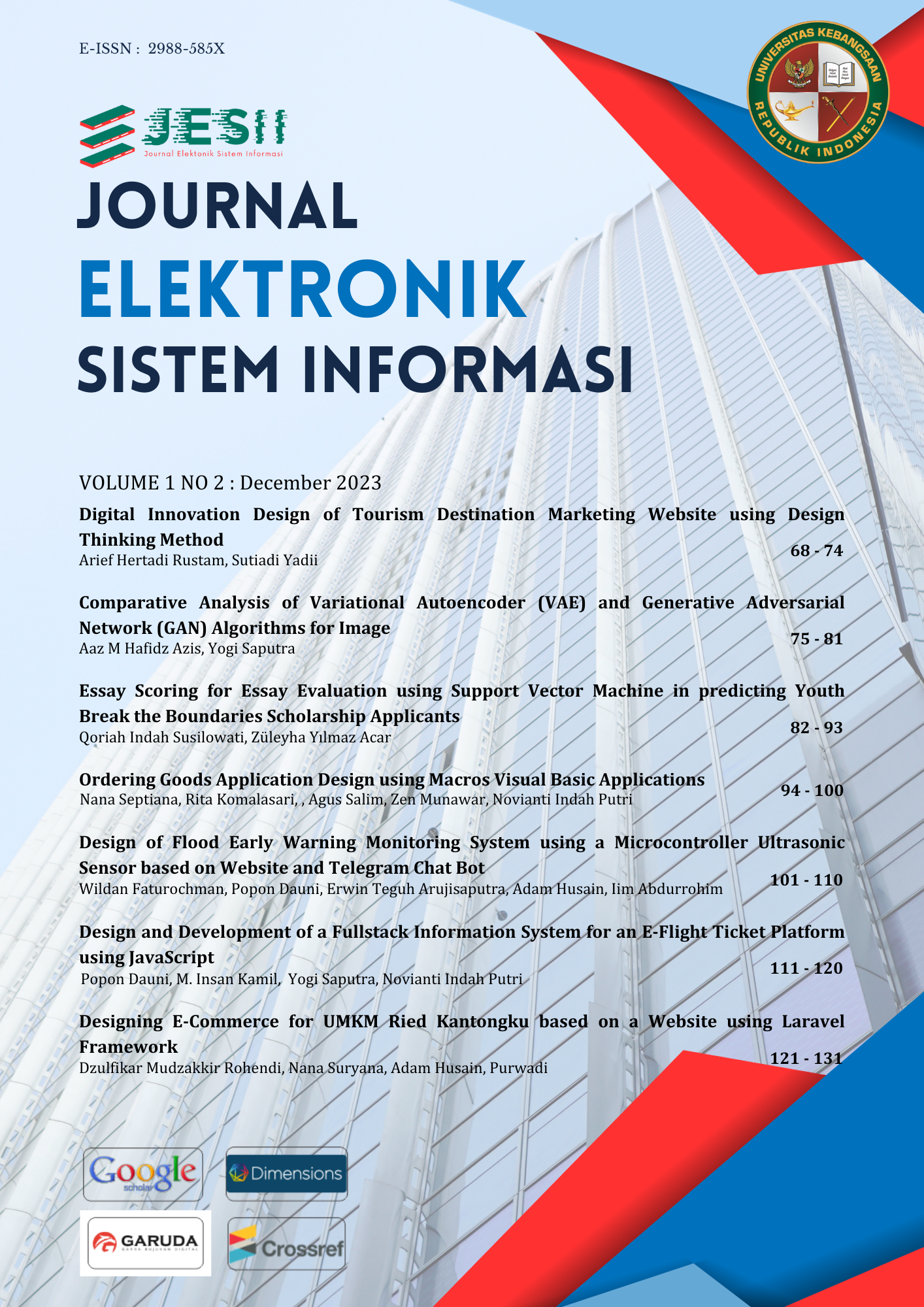
Comparative Analysis of Variational Autoencoder (VAE) and Generative Adversarial Network (GAN) Algorithms for image
DOI:
https://doi.org/10.31848/jesii.v1i2.3299Keywords:
Variational Autoencoder, Generative Adversional Network, VAE, GANAbstract
Variational Autoencoder (VAE) and Generative Adversarial Network (GAN) are topics for developing generative algorithms for image creation, image reconstruction, and data augmentation. Â These two models are solutions to models with limited data by generating data. Even though both models generate data, the way they work is different. The VAE model can produce image variations by relying on latent distributions. In contrast, GANs are models consisting of two main parts, namely a generator and a discriminator, which compete to produce increasingly realistic images. This research aims to analyze the comparison of two image-generative approaches by showing the trade-off between image realism and variation in the context of VAE and GAN. Experimental results show that GAN tends to produce more realistic and sharp images, but VAE has the advantage of producing variations in the distribution of the resulting images.References
A. Ng, “02. Generative Learning algorithms,†Course CS229: Machine Learning, no. 0, 2016.
X. Mao and Q. Li, “Generative Adversarial Networks (GANs),†in Generative Adversarial Networks for Image Generation, Singapore: Springer Singapore, 2021, pp. 1–7. doi: 10.1007/978-981-33-6048-8_1.
L. Pinheiro Cinelli, M. Araújo Marins, E. A. Barros da Silva, and S. Lima Netto, “Variational Autoencoder,†in Variational Methods for Machine Learning with Applications to Deep Networks, Cham: Springer International Publishing, 2021, pp. 111–149. doi: 10.1007/978-3-030-70679-1_5.
J. Gui, Z. Sun, Y. Wen, D. Tao, and J. Ye, “A Review on Generative Adversarial Networks: Algorithms, Theory, and Applications,†IEEE Trans Knowl Data Eng, vol. 35, no. 4, 2023, doi: 10.1109/TKDE.2021.3130191.
Q. Xu, Z. Wu, Y. Yang, and L. Zhang, “The difference learning of hidden layer between autoencoder and variational autoencoder,†in 2017 29th Chinese Control And Decision Conference (CCDC), IEEE, May 2017, pp. 4801–4804. doi: 10.1109/CCDC.2017.7979344.
D. P. Kingma and M. Welling, “Auto-encoding variational bayes,†in 2nd International Conference on Learning Representations, ICLR 2014 - Conference Track Proceedings, 2014.
H. Ohno, “Auto-encoder-based generative models for data augmentation on regression problems,†Soft comput, vol. 24, no. 11, 2020, doi: 10.1007/s00500-019-04094-0.
R. VanRullen and L. Reddy, “Reconstructing faces from fMRI patterns using deep generative neural networks,†Commun Biol, vol. 2, no. 1, 2019, doi: 10.1038/s42003-019-0438-y.
Z. Zhai, “Auto-encoder generative adversarial networks,†Journal of Intelligent and Fuzzy Systems, vol. 35, no. 3, 2018, doi: 10.3233/JIFS-169659.
X. Yi, E. Walia, and P. Babyn, “Generative adversarial network in medical imaging: A review,†Med Image Anal, vol. 58, 2019, doi: 10.1016/j.media.2019.101552.
K. Hu, Y. Zhang, C. Weng, P. Wang, Z. Deng, and Y. Liu, “An underwater image enhancement algorithm based on generative adversarial network and natural image quality evaluation index,†J Mar Sci Eng, vol. 9, no. 7, 2021, doi: 10.3390/jmse9070691.
M. Sami and I. Mobin, “A Comparative Study on Variational Autoencoders and Generative Adversarial Networks,†in 2019 International Conference of Artificial Intelligence and Information Technology (ICAIIT), IEEE, Mar. 2019, pp. 1–5. doi: 10.1109/ICAIIT.2019.8834544.
L. Liu, M. Muelly, J. Deng, T. Pfister, and L.-J. Li, “Generative Modeling for Small-Data Object Detection,†in 2019 IEEE/CVF International Conference on Computer Vision (ICCV), IEEE, Oct. 2019, pp. 6072–6080. doi: 10.1109/ICCV.2019.00617.
H. Xiao, K. Rasul, and R. Vollgraf, “Fashion-MNIST: a Novel Image Dataset for Benchmarking Machine Learning Algorithms,†Aug. 2017.
Downloads
Published
How to Cite
Issue
Section
License
Copyright (c) 2023 Aaz M Hafidz Azis

This work is licensed under a Creative Commons Attribution-ShareAlike 4.0 International License.
Authors who publish in JESII: Journal Elektronik Sistem InformasI agree to the following terms:
Authors retain copyright and grant the journal right of first publication with the work simultaneously licensed under a Attribution-ShareAlike 4.0 International (CC BY-SA 4.0) License that allows others to share the work with an acknowledgment of the work's authorship and initial publication in this journal.
Authors are able to enter into separate, additional contractual arrangements for the non-exclusive distribution of the journal's published version of the work (e.g., post it to an institutional repository or publish it in a book), with an acknowledgment of its initial publication in this journal.
Authors are permitted and encouraged to post their work online (e.g., in institutional repositories or on their website) prior to and during the submission process, as it can lead to productive exchanges, as well as earlier and greater citation of published work (See The Effect of Open Access).