Trends in AI-Generated Graphics Research: Bibliometric Analysis of Publication 2020-2025
DOI:
https://doi.org/10.31848/jesii.v3i2.4218Keywords:
Bibliometrics, VOSviewer, AI-generated graphics, Text-to-image, DALL-E, Midjourney, Stable DiffusionAbstract
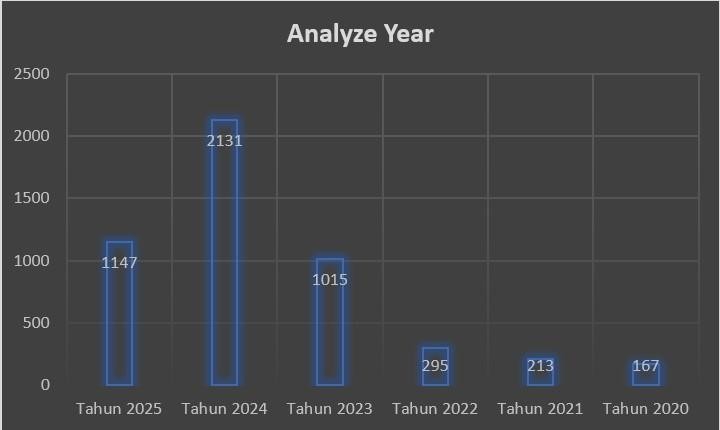
This study aims to identify trends and developments in scientific research on AI-generated graphics during the period 2020–2025 using a bibliometric approach. The analysis focuses on publication trends, institutional and country collaborations, thematic distributions, and research network visualizations. Bibliometric data were collected from the Scopus database, resulting in 4,968 scientific documents retrieved using keywords such as “AI-generated graphics,” “text-to-image,” “DALL-E,” “Stable Diffusion,” and “Midjourney.” The analysis was conducted using VOSviewer to examine keyword co-occurrence, co-authorship, co-citation, and bibliographic coupling. The results show a significant increase in publications, with a notable peak in 2024. China emerged as the leading contributor, followed by the United States, supported by major research funding institutions such as the National Natural Science Foundation of China (NSFC). Thematic analysis indicates a shift from GAN-based models toward diffusion-based text-to-image models, accompanied by growing attention to semantic, ethical, and social issues. Network visualization reveals ten major research clusters, including health, digital arts, and computer vision. Unlike previous bibliometric studies that primarily focus on general artificial intelligence or isolated generative models, this study provides a comprehensive and up-to-date mapping of AI-generated graphics research by integrating technological evolution, creative AI platforms, and ethical dimensions within a single analytical framework. These findings offer a holistic understanding of the research landscape and serve as a foundation for future technological development and interdisciplinary collaboration in AI-generated graphics.
References
A. Ramesh, P. Dhariwal, A. Nichol, C. Chu, and M. Chen, “Hierarchical Text-Conditional Image Generation with CLIP Latents,” Apr. 2022, [Online]. Available: http://arxiv.org/abs/2204.06125
A. W. Fadhlan Ramdhani and A. Susanti, “Pemanfaatan Teknologi Openai Dall-E 2 dalam Meningkatkan Kreativitas Desainer Grafis pada Komunitas Desain Grafis Indonesia,” Jurnal Bisnis dan Komunikasi Digital, vol. 1, no. 2, p. 8, Nov. 2023, doi: 10.47134/jbkd.v1i2.1916.
N. Mukaromah, S. Mulyono, and U. Islam Sultan Agung, “Jurnal Rekayasa Sistem Informasi dan Teknologi Volume 2, No 3-Februari 2025 e-ISSN : 3025-888X IMPLEMENTASI STABLE DIFFUSION DAN FINE-TUNING LOW RANK ADAPTATION UNTUK PEMBUATAN LOGO.”
B. Çeken, O. Şen, G. Tasarımı, S. ve Tasarım Fakültesi, and A. Hacı Bayram Veli Üniversitesi, “GRAFİK TASARIM SEKTÖRÜNDE YAPAY ZEKANIN KULLANILMASI (MİDJOURNEY).” [Online]. Available: http://as-proceeding.com/:Konya,Turkeyhttps://as-proceeding.com/index.php/iccar
H.-C. Chen, “Harnessing AI for Scientific Illustration: Exploring Tornado Dynamics Through Midjourney,” in 2023 12th International Conference on Awareness Science and Technology (iCAST), IEEE, 2023, pp. 136–141.
F. Fuadi, “Medkom: Jurnal Media dan Komunikasi Medkom: Jurnal Media dan Komunikasi Perkembangan Tren Publikasi Ilmiah tentang Media Sosial dan Pemilu: Sebuah Studi Bibliometrik”, [Online]. Available: https://e-journal.unair.ac.id/Medkom
N. Donthu, S. Kumar, D. Mukherjee, N. Pandey, and W. M. Lim, “How to conduct a bibliometric analysis: An overview and guidelines,” J Bus Res, vol. 133, pp. 285–296, Sep. 2021, doi: 10.1016/j.jbusres.2021.04.070.
L. Radha and J. Arumugam, “The Research Output of Bibliometrics using Bibliometrix R Package and VOS Viewer,” Shanlax International Journal of Arts, Science and Humanities, vol. 9, no. 2, pp. 44–49, Oct. 2021, doi: 10.34293/sijash.v9i2.4197.
A. Ramesh et al., “Zero-Shot Text-to-Image Generation,” Feb. 2021, [Online]. Available: http://arxiv.org/abs/2102.12092
J. Lehtinen and T. Aila NVIDIA, “Analyzing and Improving the Image Quality of StyleGAN Tero Karras NVIDIA Samuli Laine NVIDIA Miika Aittala NVIDIA Janne Hellsten NVIDIA.” [Online]. Available: https://github.com/NVlabs/stylegan2
R. Zhang et al., “Generative AI for Film Creation: A Survey of Recent Advances.”
D. Kutanova, “The use of generative graphics in graphic design: Aesthetics and ethics”, doi: 10.18533/journal.v13i2.2524.
S. Das and R. Kundu, “The Ethics of Artificial Intelligence in Creative Arts: A Comprehensive Review,” Interdisciplinary International Journal of Advances in Social Sciences, Arts and Humanities, vol. 01, no. 01, pp. 27–34, 2024, doi: 10.62674/iijassah.2024.v1i1.003.
E. Mule et al., “Enhancing Ground-to-Aerial Image Matching for Visual Misinformation Detection Using Semantic Segmentation.”
J. Ricker, D. Assenmacher, T. Holz, A. Fischer, and E. Quiring, “AI-Generated Faces in the Real World: A Large-Scale Case Study of Twitter Profile Images,” Oct. 2024, doi: 10.1145/3678890.3678922.
I. Rahkovsky, A. Toney, K. W. Boyack, R. Klavans, and D. A. Murdick, “AI Research Funding Portfolios and Extreme Growth,” Front Res Metr Anal, vol. 6, 2021, doi: 10.3389/frma.2021.630124.
Y. Li et al., “Zero-shot Medical Image Translation via Frequency-Guided Diffusion Models,” Oct. 2023, doi: 10.1109/TMI.2023.3325703.
S. Pan et al., “2D medical image synthesis using transformer-based denoising diffusion probabilistic model,” Phys Med Biol, vol. 68, no. 10, p. 105004, 2023, doi: 10.1088/1361-6560/acca5c.
C. Lu, J. Kay, and K. McKee, “Subverting machines, fluctuating identities: Re-learning human categorization,” in ACM International Conference Proceeding Series, Association for Computing Machinery, Jun. 2022, pp. 1005–1015. doi: 10.1145/3531146.3533161.
M. W. Khasbulloh, R. Suzano, A. Y. Rukmana, and R. Mesra, “Peta Keterkaitan Konsep dalam Penelitian Kepemimpinan Kewirausahaan: Analisis Bibliometrik dan Co-occurrence,” Sanskara Manajemen Dan Bisnis, vol. 1, no. 03, pp. 217–228, 2023.
Downloads
Published
How to Cite
Issue
Section
License
Copyright (c) 2025 Tamara Adjuah, Uswatun Hasanah

This work is licensed under a Creative Commons Attribution-ShareAlike 4.0 International License.
Authors who publish in JESII: Journal Elektronik Sistem InformasI agree to the following terms:
Authors retain copyright and grant the journal right of first publication with the work simultaneously licensed under a Attribution-ShareAlike 4.0 International (CC BY-SA 4.0) License that allows others to share the work with an acknowledgment of the work's authorship and initial publication in this journal.
Authors are able to enter into separate, additional contractual arrangements for the non-exclusive distribution of the journal's published version of the work (e.g., post it to an institutional repository or publish it in a book), with an acknowledgment of its initial publication in this journal.
Authors are permitted and encouraged to post their work online (e.g., in institutional repositories or on their website) prior to and during the submission process, as it can lead to productive exchanges, as well as earlier and greater citation of published work (See The Effect of Open Access).