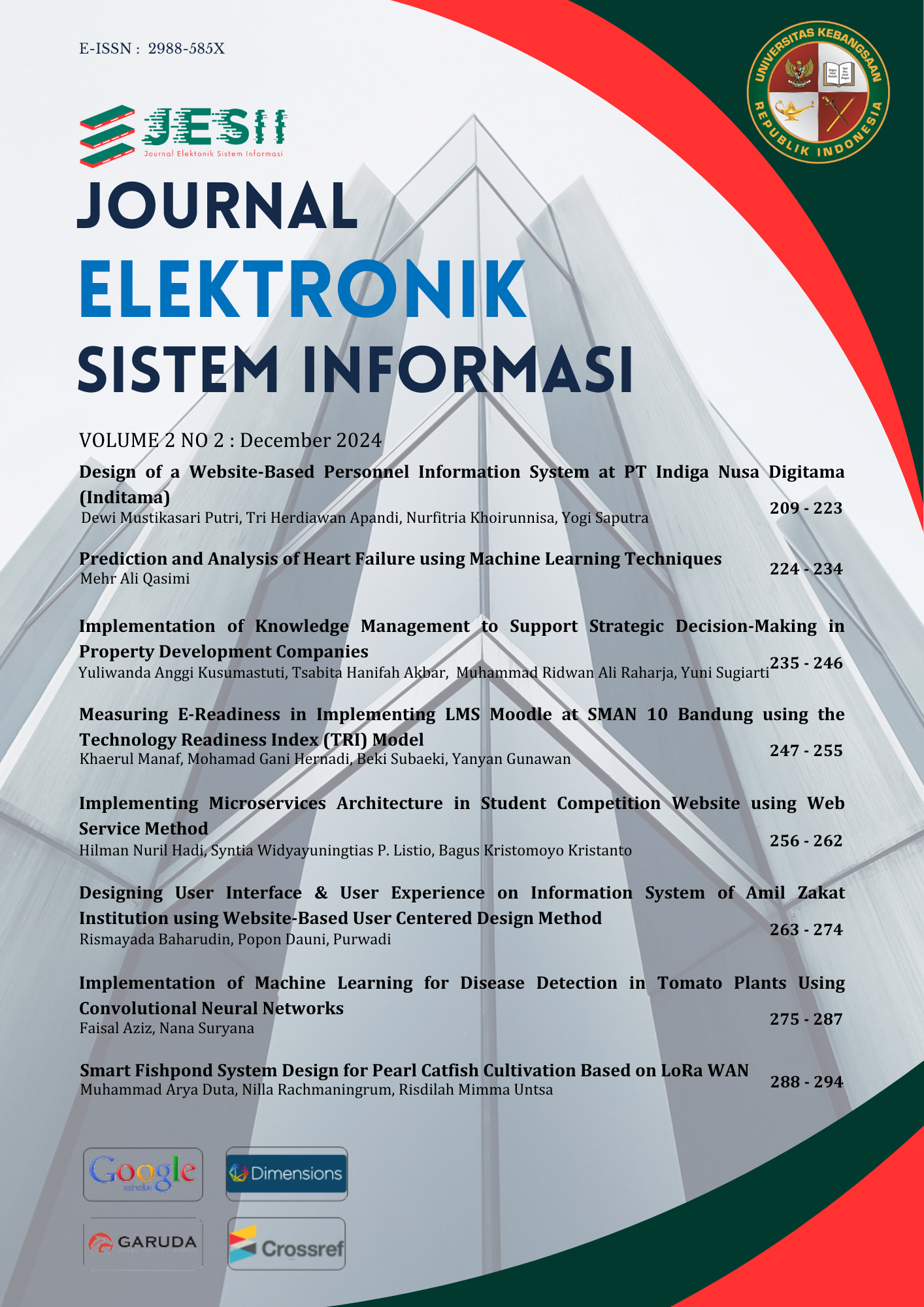
Prediction and Analysis of Heart Failure using Machine Learning Techniques
DOI:
https://doi.org/10.31848/jesii.v2i2.3541Abstract
Heart failure, which includes a variety of heart-related disorders, has become the most prevalent cause of death worldwide. Access to reliable, acceptable, and accurate procedures is essential for prompt diagnosis and proper treatment of the problem. Heart failure occurs when there is insufficient heart muscle, making the heart's pumping motion insufficient. The body's smooth functioning depends on the heart's capacity to circulate blood that is high in nutrients and oxygen to all of the body's tissues and cells. Heart failure is one of the leading causes of death globally, responsible for 17.9 million deaths each year. However, the effectiveness of current risk prediction tactics is relatively moderate, perhaps due to their reliance on statistical analytic techniques that cannot extract prognostic information from big data sets with multi-dimensional interactions. We captured associations between patient features and death using a machine-learning approach. In a cohort of 1000 patients with heart failure, different machine learning algorithms were trained to associate a subset of patient data with a very high or shallow mortality risk. The objective of this work is to use the Heart Failure dataset to undertake a thorough survival analysis and prediction. Using the current dataset of heart failure patients, the model developed for this study shows several features linked to heart failure. It is based on supervised learning techniques such as Naive Bayes, decision trees, K-nearest neighbors, and random forests. 1000 instances and twelve characteristics make up the dataset. As result the K-nearest neighbor yields the highest accuracy score.
Downloads
Published
How to Cite
Issue
Section
License
Copyright (c) 2024 Mehr Ali Qasimi

This work is licensed under a Creative Commons Attribution-ShareAlike 4.0 International License.
Authors who publish in JESII: Journal Elektronik Sistem InformasI agree to the following terms:
Authors retain copyright and grant the journal right of first publication with the work simultaneously licensed under a Attribution-ShareAlike 4.0 International (CC BY-SA 4.0) License that allows others to share the work with an acknowledgment of the work's authorship and initial publication in this journal.
Authors are able to enter into separate, additional contractual arrangements for the non-exclusive distribution of the journal's published version of the work (e.g., post it to an institutional repository or publish it in a book), with an acknowledgment of its initial publication in this journal.
Authors are permitted and encouraged to post their work online (e.g., in institutional repositories or on their website) prior to and during the submission process, as it can lead to productive exchanges, as well as earlier and greater citation of published work (See The Effect of Open Access).