Design Of A Monitoring System For Potential Of Hydrogen (Ph) In Fish Aquarium Water Based On ESP-32 Microcontroller
DOI:
https://doi.org/10.31848/jesii.v2i1.3418Abstract
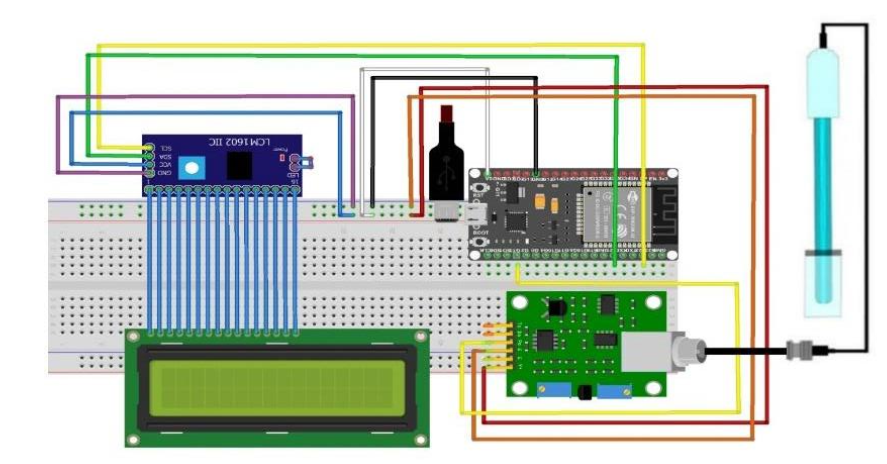
Measuring the quality and health of water in a decorative fish tank can be simplified by regularly monitoring the water pH. However, this pH monitoring is often neglected by aquarium owners due to work commitments, household responsibilities, or when they have to leave home for an extended period of time. This research designed a water pH monitoring system in an ornamental fish aquarium using a pH sensor and an ESP-32 microcontroller that can remind users through a telegram Bot message and can be seen through the LCD using the waterfall development method as a method of making tools in this study. Based on the research that has been done, the automatic pH reading system has been successfully built by being accessed via telegram and can be seen on the LCD display. pH Sensor testing has an accuracy value of 90% with testing using litmus paper comparison.
Downloads
Published
How to Cite
Issue
Section
License
Copyright (c) 2024 Aditya Awal Rizkia, Adam Husain

This work is licensed under a Creative Commons Attribution-ShareAlike 4.0 International License.
Authors who publish in JESII: Journal Elektronik Sistem InformasI agree to the following terms:
Authors retain copyright and grant the journal right of first publication with the work simultaneously licensed under a Attribution-ShareAlike 4.0 International (CC BY-SA 4.0) License that allows others to share the work with an acknowledgment of the work's authorship and initial publication in this journal.
Authors are able to enter into separate, additional contractual arrangements for the non-exclusive distribution of the journal's published version of the work (e.g., post it to an institutional repository or publish it in a book), with an acknowledgment of its initial publication in this journal.
Authors are permitted and encouraged to post their work online (e.g., in institutional repositories or on their website) prior to and during the submission process, as it can lead to productive exchanges, as well as earlier and greater citation of published work (See The Effect of Open Access).