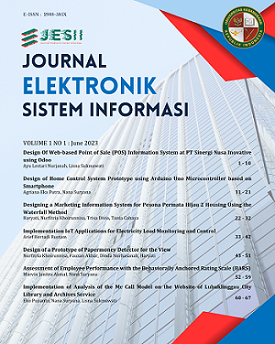
ASSESSMENT OF EMPLOYEE PERFORMANCE WITH THE BEHAVIORALLY ANCHORED RATING SCALE (BARS)
DOI:
https://doi.org/10.31848/jesii.v1i1.3195Kata Kunci:
Key Performance Indicators, Behaviorally Anchored Rating Scale, Employee Performance Assessment.Abstrak
PT. JAVFLO CIPTA MANDIRI is a company engaged in the Mechanical-Electrical field and has an office located in Bandung. Currently, the process of evaluating employee performance on Key Performance Indicators is still being done conventionally and using the rating scale method in calculating employee performance appraisals. A rating scale or measurement scale is a tool for collecting data in the form of lists containing characteristics or behaviors that must be recorded in stages to facilitate the selection of research data. Therefore we need a system that can solve these problems. The assessment method used is the Behaviorally Anchored Rating Scale (BARS) to determine the value of employee performance and the application used is SPSS (Statistical Product and Service Solutions). The purpose of this data processing is to determine the value of employee performance with the Behaviorally Anchored Rating Scale method with the SPSS application. The result of this study is the value of employee performance.Referensi
E. Setiobudi, "Analysis of Study Employee Performance Assessment Systems at PT. Tridharma Kencana,JABE (Journal Appl. Bus. Econ., vol. 3, no. 3, p. 170, 2017, doi: 10.30998/jabe.v3i3.1768.
NR Silaen, Syamsuriansyah, and R. Chaerunnisah,Employee Performance, vol. 5, no. 3. 2020.
Y. Dharma Putra, INS Kumara, NWS Ariyani, and IBA Swamardika, "Literature Review of HR Performance Analysis Using the Behaviorally Anchored Rating Scale (BARS) Method,"Maj. Science. Technol. Electro, vol. 20, no. 1, p. 103, 2021, doi: 10.24843/mite.2021.v20i01.p12.
S. Aisyah and W. Purba, "Decision Support System Application for Employee Performance Assessment Using the Profile Matching Method,"J. Mahajana Inf., vol. 4, no. 2, pp. 16–20, 2019.
O. I Gede Iwan Sudipa, Suyono, Jefri Junifer, Agus Trihandoyo, Alfry Aristo,Decision Support System. 2023.
O. Kustiadi, "Performance Assessment Design Using the Behaviorally Anchor Rating Scale Method at Pt. Zeno Alumi Indonesia,â€J. Inkofar, vol. 1, no. 1, pp. 68–78, 2018, doi: 10.46846/jurnalinkofar.v1i1.57.
NR Awani, FN Nugraha, and IA Puspita, "Performance Appraisal Design Using the Behaviorally Anchored Rating Scales ( BARS) Method in the Production Division at PT Tunggal Inti Kahuripan,"e-Proceedings Eng., vol. 5, no. 3, pp. 6857–6863, 2018, [Online]. Available: https://openlibrarypublications.telkomuniversity.ac.id/index.php/engineering/article/view/8018%0Ahttps://openlibrarypublications.telkomuniversity.ac.id/index.php/engineering/article/download/8018/ 7909
Alfriyani et al, "Designing Employee Performance Appraisal Using the Behaviorally Anchored Rating Scales (Bars) Method at Pt Widya Trans Cargo Designing Performance Appraisal Using the Behaviorally,"e-Proceedings Eng. Vol.8, vol. 8, no. 2, pp. 2253–2261, 2021, [Online]. Available: https://openlibrarypublications.telkomuniversity.ac.id/index.php/engineering/article/download/14642/14419
SN Evita, WOZ Muizu, and Raden Tri Wayu Atmojo, "Employee Performance Assessment Using the Behaviorally Anchor Rating Scale and Management By Objectives Methods (Case study at PT Qwords Company International),"Pekbis J., vol. 9, no. 1, pp. 18–32, 2019.
E. Rouza and B. Yanto, "Application of Web-Based Bars (Behaviorally Anchor Rating Scale) in Employee Performance Assessment,"Zo. J. Sist. inf., vol. 1, no. 2, pp. 115–129, 2020, doi: 10.31849/zn.v1i2.3690.
##submission.downloads##
Diterbitkan
Cara Mengutip
Terbitan
Bagian
Lisensi
Hak Cipta (c) 2023 Marvin Janitra Akmal, Nana Suryana

Artikel ini berlisensiCreative Commons Attribution-ShareAlike 4.0 International License.
Authors who publish in JESII: Journal Elektronik Sistem InformasI agree to the following terms:
Authors retain copyright and grant the journal right of first publication with the work simultaneously licensed under a Attribution-ShareAlike 4.0 International (CC BY-SA 4.0) License that allows others to share the work with an acknowledgment of the work's authorship and initial publication in this journal.
Authors are able to enter into separate, additional contractual arrangements for the non-exclusive distribution of the journal's published version of the work (e.g., post it to an institutional repository or publish it in a book), with an acknowledgment of its initial publication in this journal.
Authors are permitted and encouraged to post their work online (e.g., in institutional repositories or on their website) prior to and during the submission process, as it can lead to productive exchanges, as well as earlier and greater citation of published work (See The Effect of Open Access).