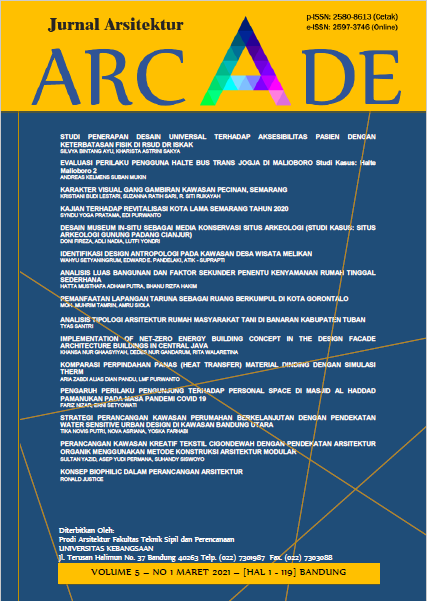
KAJIAN TERHADAP REVITALISASI KOTA LAMA SEMARANG TAHUN 2020
DOI:
https://doi.org/10.31848/arcade.v5i1.622Keywords:
Arsitektur, Revitalisasi, kota lama semarang, warisan budaya duniaAbstract
Abstract: The revitalization of the old city of Semarang was carried out because of the strong tourism potential when viewed from history and economy, besides that there are regulations regarding conservation that resulted in the Regional Medium-Term Development Plan (RPJMD) in 2016-2021 to respond to the coronation of the old city of Semarang as a tentative list ( 2015) with the aim of the UNESCO World Heritage status. The revitalization with the concept of "Little Netherland" is divided into several stages. In 2020, only 2 stages are known, namely the first stage which focuses on infrastructure and the second stage focuses on the construction of new landmarks in the form of museums. This study is more focused on the real results of the phase 1 revitalization which began in 2017 and was declared complete in mid-2020. If it is considered in general, Revitalization phase 1 is quite successful because it can revive the old city area both in terms of public interest and tourists and also the economy. because. However, in terms of history, architecture and planology, there are still many things that are considered odd, and if it is not immediately responded it will be a problem in the future, these things include: status of building ownership, vandalism, congestion, limited parking space, Incompatibility between the concept and DED, Failure to work on DED infrastructure
Abstrak: Revitalisasi Kota lama Semarang, dilakukan karna adanya potensi wisata yang kuat jika ditinjau dari sejarah dan ekonomi, selain itu adanya regulasi mengenai konservasi yang menghasilkan Rencana Pembangunan Jangka Menengah Daerah (RPJMD) pada tahun 2016-2021 untuk merespon penobatan kota lama Semarang sebagai tentative list (2015) dengan tujuan status world Heritage dari UNESCO.Revitalisasi dengan konsep “Little Netherland†ini terbagi dalam beberapa tahap. Pada tahun 2020 ini baru 2 tahap yang diketahui yaitu tahap pertama yang berfokus pada infrastruktur dan tahap kedua berkokus pada pembangunan landmark baru berupa museum. kajian ini lebih difokuskan kepada hasil nyata revtalisasi tahap 1 yang dimulai sejak tahun 2017 dan dinyatakan selesai pada petengahan tahu 2020. Bila dinilai secara awam Revitalisasi tahap 1 ini cukup berhasil karna dapat menghidupkan kembali kawasan kota lama baik dari segi animo masyarakat dan wisatawan dan juga ekonomi karna. Namun jika ditinjau dari segi sejarah, arsitektur dan juga planologi masih banyak hal yang dinilai janggal, dan di indikasi bilamana tidak segera di respon akan menjadi permasalahan kedepanya, hal-hal tersebut antara lain: Status kepemiikan bangunan, Vandalisme, Kemacetan, Keterbatasan lahan parkir, Ketidak sesuaian antara konsep dan DED, Kegagalan pengerjaan DED infrastruktur
References
Adit, Galang. (2015). Kajian Implementasi Program Revitalisasi Kawasan Kota Lama Sebagai Kawasan Pariwisata Di Kota Semarang.
Grahadwiswara, Agastya. Dkk. (2014). Pengelolaan Kawasan Kota Lama Semarang Sebagai Salah Satu Kawasan Pariwisata Di Kota Semarang. Journal Of Public Policy And Management Review. Vol 3 halaman 4 tahun 2014
Ratih, Suzanna. Dkk. (2017), Pelestarian Dan Pengembangan Kawasan Kota Lama Sebagai Landasan Budaya Kota Semarang. MODUL Vol.17 No.1 Januari-Juni 2017
UNESCO. (2015). Tentative list, Semarang old town.
BAPPEDA (2011). Grand Design Kota Lama Tahun 2011 (Buku III) Laporan Akhir. Semarang: CV. Rekayasa Jati Mandiri.
BAPPEDA (2011). Grand Design Kota Lama Tahun 2011 (Buku II) Buku Antara. Semarang : CV. Rekayasa Jati Mandiri
BAPPEDA (2016). Rencana Pembangunan Jangka Menengah Daerah Kota Semarang Tahun 2016-2021