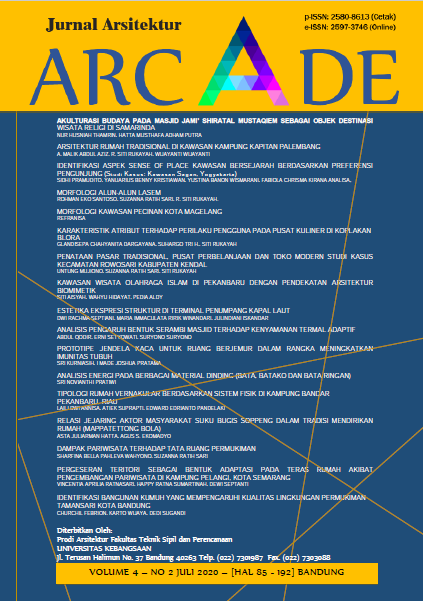
IDENTIFIKASI ASPEK SENSE OF PLACE KAWASAN BERSEJARAH BERDASARKAN PREFERENSI PENGUNJUNG (Studi Kasus: Kawasan Sagan, Yogyakarta)
DOI:
https://doi.org/10.31848/arcade.v4i3.526Keywords:
sense of place, preferensi pengunjung, kawasan SaganAbstract
Sagan area is one of the historical regions in Yogyakarta. This area has a characteristic of the Dutch colonial heritage that visitors can still feel when they are there. These characteristics then become the region's identity that can give a particular feeling or impression to visitors, or can be called a sense of place. A sense of place is an essential aspect of architecture so that a design is maintained. A sense of place is defined as the bond between place and humans, which can be obtained from a combination of physical settings, activities, and meaning. This study aims to identify aspects of the sense of place, as seen from visitor preferences. The thing observed is related to the activity, physical settings, and what is felt by visitors. By knowing the preferences of visitors, it is hoped that it can be used to create a sense of place that suits the demands of today's needs. This research was conducted qualitatively and exploratively using a grounded theory approach. Data is collected through open-ended questionnaires about what respondents experienced. The data is then processed qualitatively by the method of open coding, axial coding, and selective coding. The results showed that aspects of the Sagan region's physical setting, which are still preserved in the form of simple indische architectural features and tropical architecture, are the dominant factors that can create a sense of place. But based on an analysis of visitor preferences, changes in building functions are also needed to strengthen the sense of place of the Sagan region. Building functions that fit the character of today's visitors help visitors to feel the physical setting typical of the Sagan region. Thus it can be concluded that the sense of place can not only be formed by preserving its physical settings but also needs to be conducted a review of human preferences as actors who play a role in it.
References
Andina Syafrina, A. C. (2018, Juni). Preferensi Masyarakat tentang Lingkungan Perumahan yang Ingin Ditinggali. RUAS, 16(1), 32-45.
Budiasih, I. G. (2014, Januari). Metode Grounded Theory Dalam Riset Kualitatif. Jurnal Ilmiah Akuntansi dan Bisnis, 9(1), 19-27.
Carmona, M., CARMONA, R., Heath, T., Oc, T., & Tiesdell, S. (2003). Public Places, Urban Spaces: The Dimensions of Urban Design. Architectural Press.
Creswell, J. W. (2007). Qualitative Inquiry and Research Design: Choosing Among Five Approaches. California : Sage Publications, Inc. .
Dameria, C., Akbar, R., & Natalivan, P. (2013). Siapa Pemilik Sense of Place? . Tinjauan Dimensi Manusia dalam Konservasi Kawasan Pusaka Kota Lama , 1.
Junawan, M. (1998). Kota Baru : Pola Pemukiman Masyarakat Belanda di Yogyakarta. Yogyakarta: UGM.
Kianicka, S., Buchecker, M., Hunziker, M., & Müller-Böker, U. (2006). Locals’ and Tourists’ Sense of Place. A Case Study of a Swiss Alpine Village. Mountain Research and Development, 55-63.
Najafi, M., & Shariff, M. (2011). The Concept of Place and Sense of Place in architectural Studies. International Journal of Human and Social Sciencie.
Punter, J. (1991). Participation in the Design of Urban Space. Landscape Design 200.
Putra, H. M. (2012). Karakter Indis Kawasan Sagan Lama Yogyakarta. Politeknik Negri Samarinda, 1.
Rifaioglu, M. N., & Güçhan, N. Ş. (2008, September-Oktober). Understanding and preserving spirit of place by an integrated methodology in historical urban contexts. 16 th General Assembly and Scientific Symposium of ICOMOS (pp. 1-12). Quebec City: ICOMOS.
Shamai, S. (1991). Sense of Place : An Empirical Measurement. Geoforum, 22 (3), 347-358.
Wihardyanto, D., Haryadi, A., & Marasabessy, F. (2015). STUDI KARAKTERISTIK BENTUK PADA PERUMAHAN KOLONIAL SAGAN YOGYAKARTA. Indonesian Journal of Conservation, 34-44.
Zinas, B. Z. (2012). Housing Choice and Preference : Theory and Measurement. Procedia Social and Behavioral Sciences, 49,282-292.